


WordlyCove: A Practical Resource for Students and Content Writers
- Posted in:
- Education

Most students and content writers don’t struggle with ideas. They struggle with the small stuff—like avoiding copying someone else’s work, picking the right word, or where to put commas.
Now, on paper, these look like minor issues. But in practice, they’re usually the reasons why a good piece of writing gets marked down or sent back for a second draft. And this is exactly the gap that WordlyCove claims to address.
But does it really? Let’s find that out in this article.
What Is WordlyCove? — A Complete Overview
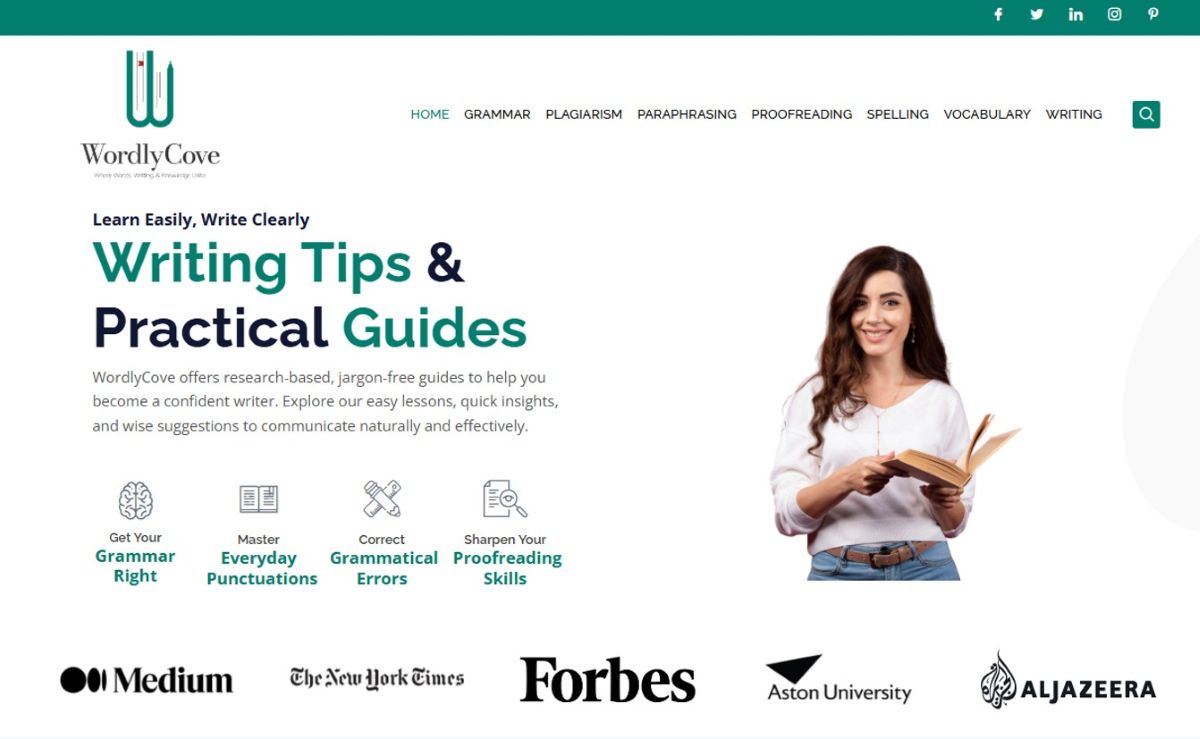
WordlyCove is an online language and writing resource that provides guides about the following concepts in simple, plain language:
- Grammar
- Paraphrasing
- Plagiarism
- Proofreading
- Punctuation
- Spelling
- Vocabulary
and
- Writing
Each guide on this website is built the same way:
It aims to explain why a rule works, instead of simply stating what the rule is.
In fact, its blog posts on ‘fewer vs. less,’ ‘which vs. that,’ and ‘who vs. whom’ show this clearly.
But how?
Well, instead of handing you a rule to memorize, those blog posts walk through the logic first and then show it in a sentence that you would actually write yourself.
But What Topics WordlyCove Actually Covers
Well, the site—WordlyCove.com—is organized around eight core areas:
- Grammar—rules that break down confusing concepts like fewer vs. less, since vs. because, who vs. whom.
- Paraphrasing—rewriting ideas in one’s own words without losing the original meaning.
- Plagiarism—understanding originality and protecting your own voice.
- Proofreading—catching mistakes before a text piece goes live.
- Punctuation—how small marks change meaning and tone.
- Spelling—common misspellings and how to avoid repeating them.
- Vocabulary—word choice guidance for clearer and more precise writing.
- Writing—bringing grammar, spelling, punctuation, and originality together into pieces that actually connect with readers
But besides these categories, we’ve also found a growing set of comparisons about writing tools, grammar checkers and AI detectors, on this site. And such guides can be useful if you’re deciding which tools are actually worth paying for.
Is WordlyCove Practical for Students?
Well, for students, grades rarely come from ideas alone. For instance, a strong argument buried under comma splices or mixed-up homophones still loses marks. So, if you just advise someone to ‘proofread it,’ it won’t work unless they know what to actually look for. Right?
And we feel like this is the place where WordlyCove.com earns its place for students.
For instance, its grammar guides give you something concrete to check against, like
- How to tell the difference between ‘its’ and ‘it’s’
- When a sentence calls for ‘because’ instead of ‘since’
- What spellcheck won’t catch on its own
And knowing such differences turns editing from guesswork into something that you can actually verify. And this matters, regardless of whether you’re finishing an essay the night before it’s due or polishing a research paper over weeks.
Is WordlyCove Practical for Content Writers?
Well, the case of content writers is a bit different from students because they deal with a different version of the same pressure. Their writing gets judged fast—by editors, by readers who’ll bounce off a page in seconds, sometimes by algorithms before either of those.
So, a grammar slip-up or a paragraph that reads like it was taken from somewhere else costs a writer their credibility, and occasionally the search engine rankings too. And the plagiarism and proofreading blog guides of WordlyCove.com directly address such issues. But how?
Well, the proofreading guides on this site are framed as tightening a full piece before publishing. And as far as the concept of plagiarism is concerned, it is explained through how originality shows up in your own writing voice, rather than a vague ‘don’t copy’ warning. Plus, if you add in the tool comparisons that we’ve mentioned earlier, a content writer gets a working reference here at WordlyCove, not just theory.
But How Reliable Is the Information on WordlyCove?
The main factor in all of this is the credibility of the person who is writing the content. And after we’ve gone through all of the published blog posts on WordlyCove.com, we’ve observed that its content comes from editors and writers who have real experience in language and writing.
That’s because the information in its guides doesn’t feel like something that’s pulled together from other sites and reworded. You can see it in the examples; they read like they were tested on real sentences, instead of getting copied from a template.
Final Verdict
Well, based on what the site actually covers, yes. Students get grammar and proofreading guidance that’s specific enough to catch the errors that quietly cost them marks. Content writers get plagiarism, proofreading, and tool-comparison content that feels like it’s built for the pressure of writing that gets judged fast.
So, both groups are working with the same core problem, small mistakes with real consequences, and from our experience, WordlyCove is built to solve exactly that.